eiffel tower 3d drawing step by step
| The Eiffel Tower | |
|---|---|
| La tour Eiffel | |
| Seen from the Champ de Mars | |
 | |
| Record pinnacle | |
| Tallest in the earth from 1889 to 1930[I] | |
| General information | |
| Type | Ascertainment tower Broadcasting tower |
| Location | 7th arrondissement, Paris, French republic |
| Coordinates | 48°51′29.6″N ii°17′forty.2″E / 48.858222°North 2.294500°Due east / 48.858222; ii.294500 Coordinates: 48°51′29.half-dozen″N 2°17′twoscore.ii″E / 48.858222°N ii.294500°Eastward / 48.858222; 2.294500 |
| Construction started | 28 January 1887 (28 January 1887) |
| Completed | 15 March 1889 (15 March 1889) |
| Opening | 31 March 1889 (31 March 1889) |
| Owner | Urban center of Paris, France |
| Direction | Société d'Exploitation de la Tour Eiffel (SETE) |
| Top | |
| Architectural | 300 m (984 ft)[i] |
| Tip | 324 m (i,063 ft)[1] |
| Top floor | 276 m (906 ft)[1] |
| Technical details | |
| Floor count | 3[2] |
| Lifts/elevators | 8[two] |
| Pattern and structure | |
| Architect | Stephen Sauvestre |
| Structural engineer | Maurice Koechlin Émile Nouguier |
| Main contractor | Compagnie des Etablissements Eiffel |
| Website | |
| toureiffel | |
| References | |
| I. ^ Eiffel Tower at Emporis | |

The Eiffel Tower ( EYE-fəl; French: bout Eiffel [tuʁ‿ɛfɛl] (  listen )) is a wrought-iron lattice tower on the Gnaw de Mars in Paris, France. It is named later on the engineer Gustave Eiffel, whose company designed and built the tower.
Locally nicknamed "La dame de fer" (French for "Iron Lady"), it was constructed from 1887 to 1889 every bit the centerpiece of the 1889 World's Fair and was initially criticized by some of France's leading artists and intellectuals for its design, but it has become a global cultural icon of France and 1 of the most recognizable structures in the world.[3] The Eiffel Tower is the most visited monument with an entrance fee in the world; 6.91 million people ascended information technology in 2015. The Tower was made a Monument historique in 1964 and named office of UNESCO Globe Heritage Site ("Paris, Banks of the Seins") in 1991.[iv]
The belfry is 324 metres (ane,063 ft) alpine, about the same height equally an 81-storey edifice, and the tallest structure in Paris. Its base is square, measuring 125 metres (410 ft) on each side. During its structure, the Eiffel Tower surpassed the Washington Monument to become the tallest man-fabricated structure in the world, a title it held for 41 years until the Chrysler Building in New York City was finished in 1930. It was the first structure in the earth to surpass both the 200-metre and 300-metre mark in meridian. Due to the improver of a broadcasting aerial at the top of the belfry in 1957, it is at present taller than the Chrysler Building by five.two metres (17 ft). Excluding transmitters, the Eiffel Belfry is the second tallest free-standing structure in France after the Millau Viaduct.
The tower has three levels for visitors, with restaurants on the start and 2d levels. The elevation level'southward upper platform is 276 k (906 ft) to a higher place the ground – the highest observation deck accessible to the public in the European Matrimony. Tickets tin be purchased to arise by stairs or lift to the beginning and second levels. The climb from basis level to the first level is over 300 steps, every bit is the climb from the beginning level to the 2nd. Although in that location is a staircase to the top level, it is usually accessible only by lift.
History
Origin
The design of the Eiffel Tower is attributed to Maurice Koechlin and Émile Nouguier, two senior engineers working for the Compagnie des Établissements Eiffel. Information technology was envisioned after word virtually a suitable centerpiece for the proposed 1889 Exposition Universelle, a world's off-white to celebrate the centennial of the French Revolution. Eiffel openly acknowledged that inspiration for a tower came from the Latting Observatory built in New York City in 1853.[v] In May 1884, working at home, Koechlin made a sketch of their thought, described past him as "a cracking pylon, consisting of four lattice girders standing apart at the base and coming together at the top, joined together by metal trusses at regular intervals".[6] Eiffel initially showed little enthusiasm, but he did approve farther study, and the two engineers then asked Stephen Sauvestre, the head of the visitor's architectural department, to contribute to the design. Sauvestre added decorative arches to the base of the tower, a drinking glass pavilion to the first level, and other embellishments.
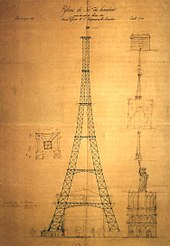
The new version gained Eiffel's support: he bought the rights to the patent on the design which Koechlin, Nougier, and Sauvestre had taken out, and the design was put on display at the Exhibition of Decorative Arts in the autumn of 1884 under the company name. On 30 March 1885, Eiffel presented his plans to the Société des Ingénieurs Civils ; subsequently discussing the technical problems and emphasising the applied uses of the tower, he finished his talk by saying the tower would symbolise
[n]ot only the art of the modern engineer, but also the century of Industry and Science in which nosotros are living, and for which the manner was prepared by the bully scientific movement of the eighteenth century and by the Revolution of 1789, to which this monument will be built equally an expression of French republic'south gratitude.[7]
Footling progress was made until 1886, when Jules Grévy was re-elected as president of French republic and Édouard Lockroy was appointed equally government minister for trade. A budget for the exposition was passed and, on 1 May, Lockroy appear an alteration to the terms of the open competition being held for a centrepiece to the exposition, which effectively fabricated the selection of Eiffel'due south design a foregone conclusion, every bit entries had to include a study for a 300 m (980 ft) four-sided metal tower on the Champ de Mars.[seven] (A 300-metre tower was so considered a herculean engineering attempt). On 12 May, a commission was set up to examine Eiffel's scheme and its rivals, which, a month later, decided that all the proposals except Eiffel's were either impractical or defective in details.
After some debate about the exact location of the tower, a contract was signed on 8 January 1887. Eiffel signed it acting in his ain capacity rather than as the representative of his company, the contract granting him 1.5 million francs toward the construction costs: less than a quarter of the estimated half dozen.5 million francs. Eiffel was to receive all income from the commercial exploitation of the tower during the exhibition and for the side by side 20 years. He later established a separate company to manage the tower, putting upward half the necessary capital letter himself.[8]
Artists' protest

Caricature of Gustave Eiffel comparing the Eiffel tower to the Pyramids, published in Le Temps, Feb 14, 1887.
The proposed belfry had been a subject of controversy, cartoon criticism from those who did not believe it was feasible and those who objected on artistic grounds. Prior to the Eiffel Tower'southward construction, no structure had e'er been constructed to a height of 300 m, or fifty-fifty 200 yard for that matter,[9] and many people believed information technology was incommunicable. These objections were an expression of a long-continuing debate in France about the relationship between architecture and technology. Information technology came to a head as piece of work began at the Champ de Mars: a "Committee of Three Hundred" (one member for each metre of the tower'due south height) was formed, led by the prominent builder Charles Garnier and including some of the nigh of import figures of the arts, such every bit William-Adolphe Bouguereau, Guy de Maupassant, Charles Gounod and Jules Massenet. A petition called "Artists against the Eiffel Tower" was sent to the Minister of Works and Commissioner for the Exposition, Adolphe Alphand, and it was published by Le Temps on xiv February 1887:
Nosotros, writers, painters, sculptors, architects and passionate devotees of the hitherto untouched beauty of Paris, protest with all our strength, with all our indignation in the name of slighted French taste, against the erection … of this useless and monstrous Eiffel Tower … To bring our arguments home, imagine for a moment a lightheaded, ridiculous tower dominating Paris like a gigantic black smokestack, crushing under its barbaric bulk Notre Dame, the Tour Saint-Jacques, the Louvre, the Dome of les Invalides, the Arc de Triomphe, all of our humiliated monuments will disappear in this ghastly dream. And for twenty years … we shall see stretching like a blot of ink the hateful shadow of the mean cavalcade of bolted sheet metallic.[10]

Gustave Eiffel responded to these criticisms by comparison his tower to the Egyptian pyramids: "My belfry will exist the tallest edifice ever erected by homo. Will it not as well exist grandiose in its manner? And why would something beauteous in Egypt become hideous and ridiculous in Paris?"[eleven] These criticisms were too dealt with by Édouard Lockroy in a letter of support written to Alphand, sardonically maxim,[12] "Judging past the stately swell of the rhythms, the beauty of the metaphors, the elegance of its fragile and precise style, ane can tell this protestation is the result of collaboration of the most famous writers and poets of our time", and he explained that the protestation was irrelevant since the project had been decided upon months before, and structure on the tower was already nether mode.
Indeed, Garnier was a fellow member of the Tower Committee that had examined the various proposals, and had raised no objection. Eiffel was similarly unworried, pointing out to a journalist that it was premature to judge the effect of the tower solely on the basis of the drawings, that the Gnaw de Mars was afar plenty from the monuments mentioned in the protest for there to be footling run a risk of the belfry overwhelming them, and putting the artful argument for the belfry: "Do non the laws of natural forces always arrange to the secret laws of harmony?"[13]
Some of the protesters changed their minds when the tower was congenital; others remained unconvinced.[14] Guy de Maupassant supposedly ate lunch in the belfry's eating house every day because it was the ane identify in Paris where the belfry was non visible.[15]
By 1918, information technology had become a symbol of Paris and of France after Guillaume Apollinaire wrote a nationalist poem in the shape of the tower (a calligram) to express his feelings most the state of war against Federal republic of germany.[xvi] Today, information technology is widely considered to exist a remarkable slice of structural art, and is often featured in films and literature.
Construction
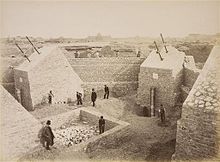
Piece of work on the foundations started on 28 January 1887.[17] Those for the east and south legs were straightforward, with each leg resting on four two thou (half-dozen.6 ft) concrete slabs, i for each of the principal girders of each leg. The due west and north legs, being closer to the river Seine, were more complicated: each slab needed 2 piles installed by using compressed-air caissons fifteen m (49 ft) long and 6 m (xx ft) in diameter driven to a depth of 22 chiliad (72 ft)[18] to support the concrete slabs, which were six m (twenty ft) thick. Each of these slabs supported a block of limestone with an inclined top to acquit a supporting shoe for the ironwork.
Each shoe was anchored to the stonework past a pair of bolts 10 cm (iv in) in diameter and 7.five thousand (25 ft) long. The foundations were completed on 30 June, and the erection of the ironwork began. The visible work on-site was complemented past the enormous amount of exacting preparatory work that took place behind the scenes: the drawing function produced i,700 full general drawings and 3,629 detailed drawings of the 18,038 different parts needed.[xix] The task of drawing the components was complicated by the circuitous angles involved in the pattern and the degree of precision required: the position of rivet holes was specified to within 1 mm (0.04 in) and angles worked out to 1 2d of arc.[20] The finished components, some already riveted together into sub-assemblies, arrived on horse-fatigued carts from a factory in the nearby Parisian suburb of Levallois-Perret and were first bolted together, with the bolts beingness replaced with rivets as construction progressed. No drilling or shaping was done on site: if any part did non fit, it was sent back to the manufacturing plant for alteration. In all, 18,038 pieces were joined together using ii.five million rivets.[17]
At first, the legs were constructed as cantilevers, but about halfway to the first level construction was paused to create a substantial timber scaffold. This renewed concerns about the structural integrity of the tower, and sensational headlines such equally "Eiffel Suicide!" and "Gustave Eiffel Has Gone Mad: He Has Been Confined in an Asylum" appeared in the tabloid press.[21] At this phase, a small "creeper" crane designed to move up the tower was installed in each leg. They made apply of the guides for the lifts which were to be fitted in the four legs. The critical stage of joining the legs at the first level was completed by the cease of March 1888.[17] Although the metalwork had been prepared with the utmost attending to detail, provision had been made to carry out small-scale adjustments to precisely marshal the legs; hydraulic jacks were fitted to the shoes at the base of operations of each leg, capable of exerting a force of 800 tonnes, and the legs were intentionally constructed at a slightly steeper angle than necessary, beingness supported by sandboxes on the scaffold. Although construction involved 300 on-site employees,[17] due to Eiffel'southward safety precautions and the apply of movable gangways, guardrails and screens, just one person died.[22]
-

18 July 1887:
The start of the erection of the metalwork -
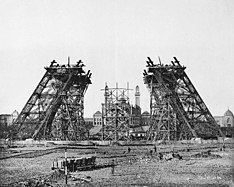
vii December 1887:
Construction of the legs with scaffolding -
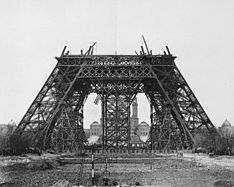
xx March 1888:
Completion of the first level -

15 May 1888:
Start of construction on the second phase -

21 Baronial 1888:
Completion of the 2nd level -

26 Dec 1888:
Construction of the upper stage -

15 March 1889:
Construction of the cupola
Lifts

The Roux, Combaluzier & Lepape lifts during construction. Note the bulldoze sprockets and chain in the foreground.
Equipping the belfry with acceptable and safe rider lifts was a major concern of the authorities committee overseeing the Exposition. Although some visitors could be expected to climb to the get-go level, or fifty-fifty the second, lifts clearly had to be the principal ways of ascent.[23]
Amalgam lifts to reach the kickoff level was relatively straightforward: the legs were wide plenty at the bottom and so almost directly that they could contain a straight track, and a contract was given to the French company Roux, Combaluzier & Lepape for two lifts to be fitted in the eastward and west legs.[24] Roux, Combaluzier & Lepape used a pair of endless chains with rigid, articulated links to which the machine was attached. Lead weights on some links of the upper or return sections of the bondage balanced most of the car's weight. The car was pushed up from below, not pulled up from above: to forestall the chain buckling, information technology was enclosed in a conduit. At the bottom of the run, the chains passed effectually three.9 one thousand (12 ft 10 in) diameter sprockets. Smaller sprockets at the meridian guided the bondage.[24]
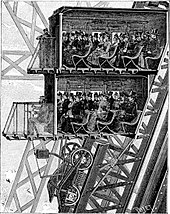
The Otis lifts originally fitted in the north and south legs
Installing lifts to the second level was more of a claiming because a straight rail was impossible. No French company wanted to undertake the work. The European co-operative of Otis Brothers & Company submitted a proposal but this was rejected: the off-white'southward lease ruled out the apply of any foreign material in the structure of the tower. The borderline for bids was extended but nonetheless no French companies put themselves forward, and somewhen the contract was given to Otis in July 1887.[25] Otis were confident they would eventually exist given the contract and had already started creating designs.[ citation needed ]
The car was divided into two superimposed compartments, each holding 25 passengers, with the lift operator occupying an outside platform on the first level. Motive power was provided past an inclined hydraulic ram 12.67 m (41 ft 7 in) long and 96.5 cm (38.0 in) in diameter in the tower leg with a stroke of x.83 m (35 ft 6 in): this moved a wagon carrying six sheaves. Five stock-still sheaves were mounted in a higher place the leg, producing an arrangement similar to a cake and tackle but acting in reverse, multiplying the stroke of the piston rather than the force generated. The hydraulic pressure in the driving cylinder was produced by a large open up reservoir on the second level. Afterwards beingness exhausted from the cylinder, the water was pumped back upwardly to the reservoir by ii pumps in the machinery room at the base of operations of the southward leg. This reservoir also provided power to the lifts to the first level.[ commendation needed ]
The original lifts for the journey between the second and 3rd levels were supplied by Léon Edoux. A pair of 81 m (266 ft) hydraulic rams were mounted on the second level, reaching most halfway up to the third level. One lift car was mounted on elevation of these rams: cables ran from the top of this motorcar up to sheaves on the third level and back down to a second car. Each car travelled only half the distance between the second and third levels and passengers were required to change lifts halfway by means of a short gangway. The 10-ton cars each held 65 passengers.[26]
Inauguration and the 1889 exposition

View of the 1889 World'southward Off-white
The primary structural work was completed at the terminate of March 1889 and, on 31 March, Eiffel celebrated past leading a group of government officials, accompanied by representatives of the printing, to the top of the tower.[14] Because the lifts were non notwithstanding in operation, the ascent was fabricated by human foot, and took over an hour, with Eiffel stopping frequently to explain various features. Most of the political party chose to finish at the lower levels, but a few, including the structural engineer, Émile Nouguier, the head of construction, Jean Compagnon, the President of the City Council, and reporters from Le Figaro and Le Monde Illustré, completed the ascent. At 2:35 pm, Eiffel hoisted a large Tricolour to the accompaniment of a 25-gun salute fired at the beginning level.[27]
There was nonetheless work to be done, particularly on the lifts and facilities, and the tower was not opened to the public until nine days afterwards the opening of the exposition on 6 May; even then, the lifts had not been completed. The tower was an instant success with the public, and virtually xxx,000 visitors made the i,710-step climb to the top before the lifts entered service on 26 May.[28] Tickets cost two francs for the first level, 3 for the second, and 5 for the top, with half-price access on Sundays,[29] and by the stop of the exhibition there had been 1,896,987 visitors.[3]
Afterwards night, the tower was lit past hundreds of gas lamps, and a beacon sent out iii beams of crimson, white and bluish lite. Two searchlights mounted on a round track were used to illuminate various buildings of the exposition. The daily opening and endmost of the exposition were announced by a cannon at the superlative.[ citation needed ]
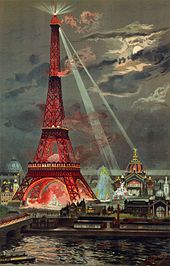
Illumination of the tower at night during the exposition
On the second level, the French paper Le Figaro had an office and a printing press, where a special gift edition, Le Figaro de la Bout, was made. There was besides a pâtisserie.[ citation needed ]
At the superlative, there was a mail function where visitors could ship letters and postcards as a memento of their visit. Graffitists were too catered for: sheets of paper were mounted on the walls each mean solar day for visitors to tape their impressions of the belfry. Gustave Eiffel described some of the responses equally vraiment curieuse ("truly curious").[30]
Famous visitors to the belfry included the Prince of Wales, Sarah Bernhardt, "Buffalo Pecker" Cody (his Wild West show was an allure at the exposition) and Thomas Edison.[28] Eiffel invited Edison to his private flat at the height of the tower, where Edison presented him with one of his phonographs, a new invention and ane of the many highlights of the exposition.[31] Edison signed the guestbook with this message:
To Chiliad Eiffel the Engineer the brave builder of then gigantic and original specimen of modern Engineering science from one who has the greatest respect and admiration for all Engineers including the Swell Engineer the Bon Dieu, Thomas Edison.
Eiffel had a permit for the tower to stand for xx years. Information technology was to be dismantled in 1909, when its ownership would revert to the Metropolis of Paris. The City had planned to tear it down (part of the original contest rules for designing a tower was that it should be easy to dismantle) merely as the tower proved to exist valuable for radio telegraphy, it was allowed to remain subsequently the death of the permit, and from 1910 it as well became office of the International Time Service.[32]
Eiffel made use of his apartment at the top of the tower to comport out meteorological observations, and likewise used the tower to perform experiments on the action of air resistance on falling bodies.[33]
Subsequent events
For the 1900 Exposition Universelle, the lifts in the e and west legs were replaced by lifts running equally far as the 2nd level constructed by the French business firm Fives-Lille. These had a compensating mechanism to keep the floor level as the angle of ascent inverse at the beginning level, and were driven by a similar hydraulic mechanism every bit the Otis lifts, although this was situated at the base of the tower. Hydraulic force per unit area was provided by pressurised accumulators located near this mechanism.[25] At the same time the lift in the due north colonnade was removed and replaced past a staircase to the kickoff level. The layout of both outset and 2d levels was modified, with the infinite available for visitors on the second level. The original lift in the south pillar was removed 13 years subsequently.[ citation needed ]
On 19 Oct 1901, Alberto Santos-Dumont, flying his No.6 airship, won a 100,000-franc prize offered past Henri Deutsch de la Meurthe for the showtime person to make a flight from St. Cloud to the Eiffel Belfry and back in less than half an 60 minutes.[34]
Many innovations took identify at the Eiffel Tower in the early 20th century. In 1910, Father Theodor Wulf measured radiant energy at the pinnacle and bottom of the tower. He constitute more than at the top than expected, incidentally discovering what are known today as cosmic rays.[35] Two years later, on 4 February 1912, Austrian tailor Franz Reichelt died after jumping from the first level of the tower (a top of 57 yard) to demonstrate his parachute pattern.[36] In 1914, at the outbreak of World War I, a radio transmitter located in the tower jammed High german radio communications, seriously hindering their accelerate on Paris and contributing to the Allied victory at the Commencement Battle of the Marne.[37] From 1925 to 1934, illuminated signs for Citroën adorned three of the tower'southward sides, making it the tallest advertizing space in the globe at the fourth dimension.[38] In April 1935, the belfry was used to brand experimental low-resolution television receiver transmissions, using a shortwave transmitter of 200 watts power. On 17 November, an improved 180-line transmitter was installed.[39]
On two separate but related occasions in 1925, the con creative person Victor Lustig "sold" the belfry for scrap metal.[forty] A year subsequently, in February 1926, pilot Leon Collet was killed trying to fly under the belfry. His aircraft became entangled in an aerial belonging to a wireless station.[41] A bust of Gustave Eiffel by Antoine Bourdelle was unveiled at the base of the north leg on 2 May 1929.[42] In 1930, the tower lost the championship of the globe's tallest structure when the Chrysler Edifice in New York City was completed.[43] In 1938, the decorative arcade effectually the outset level was removed.[44]
Upon the German language occupation of Paris in 1940, the lift cables were cut by the French. The tower was closed to the public during the occupation and the lifts were not repaired until 1946.[45] In 1940, German soldiers had to climb the tower to hoist a swastika-centered Reichskriegsflagge,[46] just the flag was so large it blew abroad just a few hours later, and was replaced by a smaller one.[47] When visiting Paris, Hitler chose to stay on the ground. When the Allies were nearing Paris in Baronial 1944, Hitler ordered General Dietrich von Choltitz, the military governor of Paris, to demolish the tower forth with the rest of the city. Von Choltitz disobeyed the social club.[48] On 25 June, before the Germans had been driven out of Paris, the German flag was replaced with a Tricolour by two men from the French Naval Museum, who narrowly beat three men led by Lucien Sarniguet, who had lowered the Tricolour on 13 June 1940 when Paris brutal to the Germans.[45]
A fire started in the tv transmitter on three January 1956, damaging the meridian of the belfry. Repairs took a year, and in 1957, the nowadays radio aerial was added to the height.[49] In 1964, the Eiffel Tower was officially alleged to be a historical monument by the Minister of Cultural Diplomacy, André Malraux.[l] A year later, an boosted lift system was installed in the north colonnade.[51]
According to interviews, in 1967, Montreal Mayor Jean Drapeau negotiated a secret understanding with Charles de Gaulle for the tower to be dismantled and temporarily relocated to Montreal to serve every bit a landmark and tourist allure during Expo 67. The plan was allegedly vetoed past the company operating the tower out of fear that the French regime could refuse permission for the tower to be restored in its original location.[52]

In 1982, the original lifts between the second and 3rd levels were replaced afterwards 97 years in service. These had been closed to the public betwixt November and March because the water in the hydraulic bulldoze tended to freeze. The new cars operate in pairs, with i counterbalancing the other, and perform the journey in one phase, reducing the journeying time from eight minutes to less than two minutes. At the same time, two new emergency staircases were installed, replacing the original spiral staircases. In 1983, the south colonnade was fitted with an electrically driven Otis lift to serve the Jules Verne eatery.[ citation needed ] The Fives-Lille lifts in the east and west legs, fitted in 1899, were extensively refurbished in 1986. The cars were replaced, and a computer arrangement was installed to completely automate the lifts. The motive power was moved from the water hydraulic organisation to a new electrically driven oil-filled hydraulic system, and the original water hydraulics were retained solely equally a counterbalance system.[51] A service elevator was added to the south pillar for moving modest loads and maintenance personnel three years afterward.[ citation needed ]
Robert Moriarty flew a Beechcraft Bonanza under the belfry on 31 March 1984.[53] In 1987, A.J. Hackett made i of his first bungee jumps from the top of the Eiffel Tower, using a special string he had helped develop. Hackett was arrested by the police.[54] On 27 October 1991, Thierry Devaux, along with mount guide Hervé Calvayrac, performed a series of acrobatic figures while bungee jumping from the second floor of the tower. Facing the Champ de Mars, Devaux used an electric winch betwixt figures to go support to the second floor. When firemen arrived, he stopped after the sixth jump.[55]
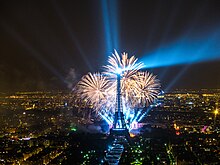
The tower is the focal bespeak of New Yr's Eve and Bastille Day (fourteen July) celebrations in Paris.
For its "Countdown to the Twelvemonth 2000" celebration on 31 Dec 1999, flashing lights and high-powered searchlights were installed on the tower. During the last three minutes of the twelvemonth, the lights were turned on starting from the base of the tower and continuing to the top to welcome 2000 with a huge fireworks prove. An exhibition above a cafeteria on the first floor commemorates this effect. The searchlights on summit of the belfry made it a buoy in Paris's night sky, and 20,000 flashing bulbs gave the tower a sparkly appearance for v minutes every hour on the hour.[56]
The lights sparkled blue for several nights to herald the new millennium on 31 December 2000. The sparkly lighting continued for 18 months until July 2001. The sparkling lights were turned on once more on 21 June 2003, and the display was planned to last for 10 years earlier they needed replacing.[57]
The tower received its 200,000,000th guest on 28 Nov 2002.[58] The tower has operated at its maximum capacity of most seven million visitors per year since 2003.[59] In 2004, the Eiffel Tower began hosting a seasonal ice rink on the first level.[threescore] A glass floor was installed on the showtime level during the 2022 refurbishment.[61]
In 2016, during Valentine'southward Day, the performance UN BATTEMENT [62] past French artist Milène Guermont unfolds amidst the Eiffel Tower, the Montparnasse Belfry and the contemporary artwork PHARES installed on the Place de la Concorde. This interactive pyramid-shaped sculpture allows the public to transmit the chirapsia of their hearts thanks to a cardiac sensor. The Eiffel Belfry and the Montparnasse Tower also light upwards to the rhythm of PHARES. This is the get-go time that the Eiffel Tower has interacted with a work of art.[ citation needed ]
Design
Material
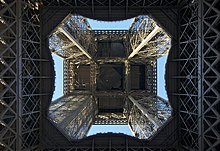
The Eiffel Belfry from below
The puddle atomic number 26 (wrought iron) of the Eiffel Tower weighs vii,300 tonnes,[63] and the addition of lifts, shops and antennae accept brought the full weight to approximately 10,100 tonnes.[64] Every bit a demonstration of the economic system of design, if the 7,300 tonnes of metallic in the construction were melted down, it would fill the square base of operations, 125 metres (410 ft) on each side, to a depth of simply 6.25 cm (2.46 in) assuming the density of the metallic to be 7.8 tonnes per cubic metre.[65] Additionally, a cubic box surrounding the belfry (324 k × 125 m × 125 m) would contain 6,200 tonnes of air, weighing almost as much as the iron itself. Depending on the ambient temperature, the elevation of the tower may shift away from the sun by up to 18 cm (7 in) due to thermal expansion of the metal on the side facing the lord's day.[66]
Wind considerations
When information technology was built, many were shocked by the tower'south daring form. Eiffel was accused of trying to create something artistic with no regard to the principles of technology. However, Eiffel and his team – experienced bridge builders – understood the importance of current of air forces, and knew that if they were going to build the tallest construction in the world, they had to be sure information technology could withstand them. In an interview with the newspaper Le Temps published on 14 February 1887, Eiffel said:
Is it non true that the very conditions which give strength besides adjust to the hidden rules of harmony? … At present to what miracle did I have to give primary business in designing the Tower? It was wind resistance. Well and so! I hold that the curvature of the monument's four outer edges, which is every bit mathematical adding dictated it should exist … will give a great impression of force and beauty, for information technology will reveal to the eyes of the observer the boldness of the blueprint as a whole.[67]
He used graphical methods to determine the force of the tower and empirical testify to account for the effects of wind, rather than a mathematical formula. Shut examination of the tower reveals a basically exponential shape.[68] All parts of the tower were overdesigned to ensure maximum resistance to wind forces. The top half was fifty-fifty assumed to have no gaps in the latticework.[69] In the years since it was completed, engineers have put frontward diverse mathematical hypotheses in an endeavour to explain the success of the design. The virtually recent, devised in 2004 afterwards letters sent by Eiffel to the French Society of Ceremonious Engineers in 1885 were translated into English, is described as a non-linear integral equation based on counteracting the air current pressure on whatsoever point of the belfry with the tension between the construction elements at that point.[68]
The Eiffel Belfry sways by up to ix cm (3.five in) in the wind.[70]
Accommodation
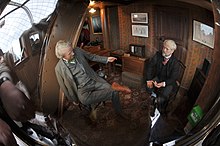
Gustave Eiffel's apartment
When originally congenital, the first level contained 3 restaurants – i French, one Russian and one Flemish — and an "Anglo-American Bar". After the exposition closed, the Flemish eatery was converted to a 250-seat theatre. A promenade 2.6-metre (8 ft 6 in) wide ran effectually the outside of the get-go level. At the top, there were laboratories for various experiments, and a small flat reserved for Gustave Eiffel to entertain guests, which is at present open to the public, consummate with period decorations and lifelike mannequins of Eiffel and some of his notable guests.[71]
In May 2016, an flat was created on the first level to suit 4 contest winners during the UEFA Euro 2022 football game tournament in Paris in June. The apartment has a kitchen, two bedrooms, a lounge, and views of Paris landmarks including the Seine, Sacré-Cœur, and the Arc de Triomphe.[72]
Passenger lifts
The arrangement of the lifts has been changed several times during the belfry's history. Given the elasticity of the cables and the fourth dimension taken to marshal the cars with the landings, each lift, in normal service, takes an average of eight minutes and fifty seconds to do the round trip, spending an boilerplate of 1 infinitesimal and 15 seconds at each level. The average journey time between levels is 1 minute. The original hydraulic mechanism is on public display in a small museum at the base of the east and westward legs. Because the mechanism requires frequent lubrication and maintenance, public admission is often restricted. The rope mechanism of the north tower can exist seen as visitors exit the lift.[73]
Engraved names

Names engraved on the belfry
Gustave Eiffel engraved on the tower the names of 72 French scientists, engineers and mathematicians in recognition of their contributions to the building of the tower. Eiffel chose this "invocation of science" because of his business over the artists' protestation. At the get-go of the 20th century, the engravings were painted over, but they were restored in 1986–87 by the Société Nouvelle d'exploitation de la Tour Eiffel , a company operating the tower.[74]
Aesthetics
The tower is painted in three shades: lighter at the top, getting progressively darker towards the lesser to complement the Parisian heaven.[75] It was originally scarlet brownish; this changed in 1968 to a bronze color known as "Eiffel Tower Brown".[76]
The only non-structural elements are the four decorative grill-work arches, added in Sauvestre's sketches, which served to brand the tower look more than substantial and to brand a more impressive entrance to the exposition.[77]
A pop-culture movie cliché is that the view from a Parisian window always includes the tower.[78] In reality, since zoning restrictions limit the height of nigh buildings in Paris to 7 storeys, only a small number of tall buildings have a clear view of the tower.[79]
Maintenance
Maintenance of the tower includes applying 60 tons of paint every seven years to prevent it from rusting. The tower has been completely repainted at to the lowest degree 19 times since information technology was built. Pb paint was still beingness used every bit recently equally 2001 when the exercise was stopped out of concern for the environment.[57] [80]

Panorama of Paris and its suburbs from the top of the Eiffel Belfry
Tourism
Transport
The nearest Paris Métro station is Bir-Hakeim and the nearest RER station is Champ de Mars-Tour Eiffel.[81] The tower itself is located at the intersection of the quai Branly and the Pont d'Iéna.
Popularity

Number of visitors per twelvemonth between 1889 and 2004
More than 250 million people accept visited the tower since it was completed in 1889.[iii] In 2015, there were 6.91 million visitors.[82] The tower is the near-visited paid monument in the globe.[83] An average of 25,000 people ascend the tower every day which can result in long queues.[84]
Restaurants
The tower has ii restaurants: Le 58 Bout Eiffel on the offset level, and Le Jules Verne , a gourmet eating house with its own lift on the second level. This restaurant has one star in the Michelin Cherry-red Guide. It was run past the multi-Michelin star chef Alain Ducasse from 2007 to 2017.[85] Starting May 2019, it will exist managed by iii-star chef Frédéric Anton.[86] It owes its name to the famous science-fiction writer Jules Verne. Additionally, at that place is a champagne bar at the tiptop of the Eiffel Tower.
From 1937 until 1981, in that location was a restaurant near the acme of the belfry. It was removed due to structural considerations; engineers had determined it was besides heavy and was causing the tower to sag.[87] This restaurant was sold to an American restaurateur and transported to New York and so New Orleans. It was rebuilt on the edge of New Orleans' Garden District as a restaurant and later consequence hall.[88]
Replicas

Equally i of the most iconic landmarks in the earth, the Eiffel Belfry has been the inspiration for the creation of many replicas and similar towers. An early on example is Blackpool Tower in England. The mayor of Blackpool, Sir John Bickerstaffe, was so impressed on seeing the Eiffel Tower at the 1889 exposition that he commissioned a similar belfry to be built in his town. It opened in 1894 and is 158.one m (518 ft) tall.[89] Tokyo Tower in Japan, congenital as a communications belfry in 1958, was also inspired past the Eiffel Belfry.[ninety]
There are diverse calibration models of the tower in the The states, including a one-half-scale version at the Paris Las Vegas, Nevada, i in Paris, Texas built in 1993, and 2 1:3 calibration models at Kings Island, located in Bricklayer, Ohio, and Kings Rule, Virginia, amusement parks opened in 1972 and 1975 respectively. 2 1:3 scale models can be found in Red china, i in Durango, Mexico that was donated by the local French community, and several across Europe.[91]
In 2011, the Television show Pricing the Priceless on the National Geographic Channel speculated that a full-size replica of the tower would cost approximately US$480 million to build.[92] This would be more than ten times the cost of the original (nearly viii meg in 1890 Francs; ~US$40 million in 2022 dollars).
Communications

The tower has been used for making radio transmissions since the beginning of the 20th century. Until the 1950s, sets of aerial wires ran from the cupola to anchors on the Avenue de Suffren and Champ de Mars. These were connected to longwave transmitters in small bunkers. In 1909, a permanent underground radio center was built near the south pillar, which withal exists today. On 20 November 1913, the Paris Observatory, using the Eiffel Tower equally an aerial, exchanged wireless signals with the U.s.a. Naval Observatory, which used an aerial in Arlington, Virginia. The object of the transmissions was to mensurate the departure in longitude betwixt Paris and Washington, D.C.[93] Today, radio and digital television signals are transmitted from the Eiffel Belfry.
FM radio
| Frequency | kW | Service |
|---|---|---|
| 87.8 MHz | ten | France Inter |
| 89.0 MHz | 10 | RFI Paris |
| 89.ix MHz | 6 | TSF Jazz |
| ninety.4 MHz | 10 | Nostalgie |
| 90.9 MHz | iv | Chante France |
Digital tv set
A television antenna was first installed on the tower in 1957, increasing its height by xviii.7 1000 (61.iv ft). Work carried out in 2000 added a further 5.iii 1000 (17.4 ft), giving the electric current peak of 324 1000 (1,063 ft).[57] Analogue television signals from the Eiffel Tower ceased on 8 March 2011.
| Frequency | VHF | UHF | kW | Service |
|---|---|---|---|---|
| 182.25 MHz | 6 | — | 100 | Culvert+ |
| 479.25 MHz | — | 22 | 500 | France two |
| 503.25 MHz | — | 25 | 500 | TF1 |
| 527.25 MHz | — | 28 | 500 | France 3 |
| 543.25 MHz | — | 30 | 100 | France five |
| 567.25 MHz | — | 33 | 100 | M6 |
Illumination copyright

The Eiffel Belfry illuminated in 2015
The tower and its prototype have been in the public domain since 1993, lxx years afterward Eiffel's death.[94] In June 1990 a French court ruled that a special lighting display on the tower in 1989 to marking the tower's 100th ceremony was an "original visual creation" protected by copyright. The Court of Cassation, France's judicial court of last resort, upheld the ruling in March 1992.[95] The Société d'Exploitation de la Bout Eiffel (SETE) now considers whatever illumination of the tower to be a split work of art that falls under copyright.[96] As a result, the SNTE alleges that it is illegal to publish contemporary photographs of the lit belfry at night without permission in France and another countries for commercial utilise.[97] [98] For this reason, it is often rare to detect images or videos of the lit tower at nighttime on stock prototype sites,[99] and media outlets rarely broadcast images or videos of information technology.[100]
The imposition of copyright has been controversial. The Director of Documentation for what was and so called the Société Nouvelle d'exploitation de la Tour Eiffel (SNTE), Stéphane Dieu, commented in 2005: "Information technology is really just a manner to manage commercial utilize of the image, and then that it isn't used in means [of which] nosotros don't corroborate".[101] SNTE made over €one million from copyright fees in 2002.[102] However, it could also be used to restrict the publication of tourist photographs of the tower at night, likewise as hindering non-turn a profit and semi-commercial publication of images of the illuminated tower.[103]
The copyright claim itself has never been tested in courts to appointment, co-ordinate to a 2022 article in the Art Law Journal, and there has never been an attempt to track down millions of netizens who have posted and shared their images of the illuminated tower on the Internet worldwide. It added, all the same, that permissive situation may ascend on commercial utilize of such images, like in a magazine, on a movie poster, or on product packaging.[104]
French doctrine and jurisprudence allows pictures incorporating a copyrighted work as long as their presence is incidental or accessory to the bailiwick being represented,[105] a reasoning akin to the de minimis dominion. Therefore, SETE may be unable to claim copyright on photographs of Paris which happen to include the lit belfry.
Height changes
The tiptop meridian of the Eiffel Tower has changed multiple times over the years as described in the chart below.[106]
| From | To | Tiptop m | Height ft | Blazon of add-on | Remarks |
|---|---|---|---|---|---|
| 1889 | 1957 | 312.27 | one,025 | Flagpole | Architectural height of 300 m 984 ft. Tallest freestanding construction in the globe until surpassed past the Chrysler building in 1930. Tallest tower in the world until surpassed by the KCTV Broadcast Tower in 1956. |
| 1957 | 1991 | 320.75 | 1,052 | Antenna | Broadcast antenna added in 1957 which made it the tallest tower in the world until the Tokyo Tower was completed the post-obit year in 1958. |
| 1991 | 1994 | 317.96 | one,043 | Antenna change | |
| 1994 | 2000 | 318.7 | 1,046 | Antenna change | |
| 2000 | Electric current | 324 | 1,063 | Antenna modify |
Taller structures
The Eiffel Belfry was the world's tallest construction when completed in 1889, a distinction it retained until 1929 when the Chrysler Building in New York City was topped out.[107] The belfry also lost its standing as the world's tallest tower to the Tokyo Tower in 1958 only retains its status as the tallest freestanding (non-guyed) construction in France.
Lattice towers taller than the Eiffel Tower
| Proper name | Pinnacle height | Year | Country | Boondocks | Remarks |
|---|---|---|---|---|---|
| Tokyo Skytree | 634 chiliad (two,080 ft) | 2011 | Japan | Tokyo | |
| Kyiv Boob tube Tower | 385 thou (ane,263 ft) | 1973 | Ukraine | Kyiv | |
| Dragon Belfry | 336 thousand (one,102 ft) | 2000 | Red china | Harbin | |
| Tokyo Tower | 333 m (1,093 ft) | 1958 | Japan | Tokyo | |
| WITI Television set Belfry | 329.4 k (one,081 ft) | 1962 | United States | Shorewood, Wisconsin | |
| St. Petersburg Television Tower | 326 k (1,070 ft) | 1962 | Russian federation | Petrograd |
Structures in France taller than the Eiffel Belfry
| Proper noun | Meridian superlative | Twelvemonth | Structure blazon | Town | Remarks |
|---|---|---|---|---|---|
| Longwave transmitter Allouis | 350 thou (1,150 ft) | 1974 | Guyed mast | Allouis | |
| HWU transmitter | 350 m (1,150 ft) | 1971 | Guyed mast | Rosnay | Military VLF transmitter; multiple masts |
| Viaduc de Millau | 343 m (one,125 ft) | 2004 | Span colonnade | Millau | |
| Boob tube Mast Niort-Maisonnay | 330 m (1,080 ft) | 1978 | Guyed mast | Niort | |
| Transmitter Le Mans-Mayet | 342 m (1,122 ft) | 1993 | Guyed mast | Mayet | |
| La Regine transmitter | 330 m (1,080 ft) | 1973 | Guyed mast | Saissac | Military VLF transmitter |
| Transmitter Roumoules | 330 thou (one,080 ft) | 1974 | Guyed mast | Roumoules | Spare transmission mast for longwave; insulated against ground |
See also
- Eiffel Tower in popular culture
- List of tallest buildings and structures in the Paris region
- Listing of tallest buildings and structures in the world
- List of tallest towers in the world
- List of tallest freestanding structures in the world
- List of tallest freestanding steel structures
- List of manual sites
- Lattice tower
- Eiffel Belfry, 1909–1928 painting series by Robert Delaunay
References
Notes
- ^ a b c "Eiffel Tower". CTBUH Skyscraper Center.
- ^ a b Eiffel Tower at Emporis
- ^ a b c SETE. "The Eiffel Tower at a glance". Official Eiffel Tower website. Archived from the original on xiv April 2016. Retrieved fifteen April 2016.
- ^ Clayson, S. Hollis (26 February 2020), "Eiffel Belfry", Architecture, Planning, and Preservation, Oxford University Press, doi:10.1093/obo/9780190922467-0014, ISBN978-0-19-092246-seven , retrieved xiv Nov 2021
- ^ Engineering News and American Railway Periodical. Vol. 22. 1000. H. Frost. 1889. p. 482.
- ^ Harvie, p. 78.
- ^ a b Loyrette, p. 116.
- ^ Loyrette, p. 121.
- ^ "Diagrams - SkyscraperPage.com". skyscraperpage.com.
- ^ Loyrette, p. 174.
- ^ Paul Souriau; Manon Souriau (1983). The Aesthetics of Movement. University of Massachusetts Press. p. 100. ISBN0-87023-412-9.
- ^ Harvie, p. 99.
- ^ Loyrette, p. 176.
- ^ a b "The Eiffel Tower". News. The Times. No. 32661. London. 1 Apr 1889. col B, p. 5.
- ^ Jill Jonnes (2009). Eiffel's Tower: And the World'southward Off-white where Buffalo Bill Beguiled Paris, the Artists Quarreled, and Thomas Edison Became a Count . Viking. pp. 163–64. ISBN978-0-670-02060-7.
- ^ Guillaume Apollinaire (1980). Anne Hyde Greet (ed.). Calligrammes: Poems of Peace and War (1913–1916). Academy of California Press. pp. 411–414. ISBN978-0-520-01968-three.
- ^ a b c d SETE. "Origins and construction of the Eiffel Tower". Official Eiffel Tower website. Archived from the original on 31 July 2015. Retrieved i Jan 2014.
- ^ Loyrette, p. 123.
- ^ Loyrette, p. 148.
- ^ Eiffel, G; The Eiffel TowerPlate X
- ^ Harvie, p. 110.
- ^ "Construction of the Eiffel Tower". wonders-of-the-world.net.
- ^ Vogel, pp. xx–21.
- ^ a b Vogel, p. 28.
- ^ a b Vogel, pp. 23–24.
- ^ Eiffel, Gustave (1900). La Bout de Trois Cents Mètres (in French). Paris: Société des imprimeries Lemercier. pp. 171–3.
- ^ Harvie, pp. 122–23.
- ^ a b SETE. "The Eiffel Tower during the 1889 Exposition Universelle". Official Eiffel Tower website. Archived from the original on 25 Apr 2016. Retrieved xvi Apr 2016.
- ^ Harvie, pp. 144–45.
- ^ Eiffel, Gustave (1900). La Tour de Trois Cents Mètres. Paris: Lemercier. p. 335.
- ^ Jill Jonnes (23 May 2009). "Thomas Edison at the Eiffel Tower". Wonders and Marvels. Retrieved 2 January 2014.
- ^ Michelin Paris: Tourist Guide (five ed.). Michelin Tyre Public Limited. 1985. p. 52. ISBN9782060135427.
- ^ Watson, p. 829.
- ^ "M. Santos Dumont's Balloon". News. The Times. No. 36591. London. 21 Oct 1901. col A, p. 4.
- ^ Theodor Wulf. Physikalische Zeitschrift. Contains results of the four-24-hour interval-long observation done by Theodor Wulf at the peak of the Eiffel Tower in 1910.
- ^ "L'inventeur d'un parachute se lance de le tour Eiffel et s'écrase sur le sol". Le Petit Parisien (in French). 5 February 1912. p. 1. Retrieved 26 November 2009.
- ^ Barbara Wertheim Tuchman (1994). August 1914. Papermac. p. 236. ISBN978-0-333-30516-4.
- ^ Smith, Oliver (31 March 2018). "40 fascinating facts most the Eiffel Tower". The Daily Telegraph . Retrieved 14 November 2019.
- ^ Stephen Herbert (2004). A History of Early on Boob tube. Vol. two. Taylor & Francis. p. forty. ISBN978-0-415-32667-4.
- ^ Piers Letcher (2003). Eccentric France: The Bradt Guide to Mad, Magical and Marvellous France. Bradt Travel Guides. p. 105. ISBN978-1-84162-068-8.
- ^ "An air tragedy". The Dominicus Times. Perth, WA. 28 February 1926. Retrieved 2 January 2012.
- ^ Harriss, p. 178.
- ^ Claudia Roth Pierpont (18 November 2002). "The Silver Spire: How 2 men'south dreams changed the skyline of New York". The New Yorker. Archived from the original on 27 February 2012.
- ^ Harriss, p. 195.
- ^ a b Harriss, pp. 180–84.
- ^ "Hard disk Stock Video Footage – The Germans unfurl Nazi flags at the captured Palace of Versailles and Eiffel Tower during the Battle of French republic". www.criticalpast.com.
- ^ Smith, Oliver (iv February 2016). "Eiffel Belfry: 40 fascinating facts". The Telegraph – via www.telegraph.co.uk.
- ^ Carlo D'Este (2003). Eisenhower: A Soldier's Life. Henry Holt and Company. p. 574. ISBN978-0-8050-5687-7.
- ^ SETE. "The major events". Official Eiffel Tower website. Archived from the original on 31 March 2015. Retrieved 13 March 2014.
- ^ Harriss, p. 215.
- ^ a b SETE. "The Eiffel Tower's lifts". Official Eiffel Tower website. Archived from the original on seven April 2016. Retrieved fifteen April 2016.
- ^ Nick Auf der Maur (15 September 1980). "How this urban center near got the Eiffel Tower". The Montreal Gazette . Retrieved 29 May 2013.
- ^ Robert J. Moriarty. "A Bonanza in Paris". Air & Space Mag . Retrieved iv April 2008.
- ^ Jano Gibson (27 February 2007). "Extreme bid to stretch bungy record". Sydney Morning time Herald . Retrieved 24 May 2010.
- ^ "Tour Eiffel". Thierry Devaux (in French). Retrieved 19 March 2019.
- ^ SETE. "The Eiffel Tower's illuminations". Official Eiffel Tower website. Archived from the original on 22 August 2015. Retrieved 31 May 2014.
- ^ a b c SETE. "All you need to know nigh the Eiffel Tower" (PDF). Official Eiffel Belfry website . Retrieved 15 April 2016.
- ^ "The Eiffel Tower". France.com. 23 October 2003. Retrieved sixteen Apr 2016.
- ^ Denis Cosnard (21 Apr 2014). "Eiffel Belfry renovation work aims to take profits to new heights". The Guardian . Retrieved 14 Apr 2016.
- ^ Darwin Porter; Danforth Prince; G. McDonald; H. Mastrini; Southward. Marking; A. Princz; C. Bánfalvy; A. Kutor; N. Lakos; Due south. Rowan Kelleher (2006). Frommer's Europe (9th ed.). Wiley. p. 318. ISBN978-0-471-92265-0.
- ^ "Eiffel Tower gets glass floor in refurbishment projection". BBC News. half-dozen October 2014. Retrieved 6 October 2014.
- ^ "PHARES (2015)". Milène GUERMONT.
- ^ David A. Hanser (2006). Architecture of France. Greenwood Publishing Grouping. p. 66. ISBN978-0-313-31902-0.
- ^ DK Eyewitness Travel Guide: Europe. Dorling Kindersley. 2012. p. 163. ISBN978-1-4093-8577-vi.
- ^ Harriss, p. threescore.
- ^ Harriss, p. 231.
- ^ SETE. "Debate and controversy surrounding the Eiffel Tower". Official Eiffel Tower website. Archived from the original on eight September 2015. Retrieved two January 2013.
- ^ a b "Elegant shape of Eiffel Tower solved mathematically by University of Colorado professor". Scientific discipline Daily. 7 January 2005. Retrieved 24 May 2010.
- ^ Watson, p. 807.
- ^ SETE. "FAQ: History/Technical". Official Eiffel Tower website. Archived from the original on viii April 2016. Retrieved sixteen Apr 2016.
- ^ Caitlin Morton (31 May 2015). "There is a secret apartment at the meridian of the Eiffel Belfry". Architectural Digest. Conde Nast. Retrieved thirty June 2015.
- ^ Mary Papenfuss (xx May 2016). "Tourists have the chance to get an Eiffel of the view by staying in the Tower for a night". International Business Times . Retrieved 21 May 2016.
- ^ Eiffel Tower, Paris, France hisour.com. Retrieved 29 August 2021
- ^ SETE (2010). "The Eiffel Tower Laboratory". Official Eiffel Belfry website. Archived from the original on 12 February 2017. Retrieved 25 January 2017.
- ^ SETE. "The Eiffel Belfry gets beautified" (PDF). Official Eiffel Tower website. Archived from the original (PDF) on 21 November 2015. Retrieved 8 Nov 2015.
- ^ SETE. "Painting the Eiffel Tower". Official Eiffel Tower website. Archived from the original on 26 Oct 2016. Retrieved 25 January 2017.
- ^ "History: Development of clear span buildings – Exhibition buildings". Architectural Teaching Resource. Tata Steel Europe, Ltd. Archived from the original on five October 2013. Retrieved 4 Jan 2014.
- ^ "The Eiffel Tower". France.com. Retrieved 27 January 2018.
- ^ "Eiffel Tower (Paris ( 7 th ), 1889)". Structurae . Retrieved 27 February 2021.
- ^ Bavelier, Ariane (3 December 2013). "Coup de pinceau sur la bout Eiffel". Lefigaro . Retrieved 28 March 2009.
- ^ SETE. "Getting to the Eiffel Tower". Official Eiffel Tower website. Archived from the original on 14 April 2016. Retrieved 16 April 2016.
- ^ "Number of Eiffel Tower visitors falls in wake of Paris attacks". French republic 24. 20 January 2016. Retrieved 15 Apr 2016.
- ^ Jean-Michel Normand (23 July 2007). "Tour Eiffel et souvenirs de Paris". Le Monde. France. Retrieved 24 May 2010.
- ^ "Eiffel Tower reopens to tourists after rare closure for 2-day strike". Fox News. Associated Printing. 27 June 2013. Retrieved sixteen Apr 2016.
- ^ Dali Wiederhoft. "Eiffel Tower: Sightseeing, restaurants, links, transit". Bonjour Paris. Archived from the original on 6 January 2014.
- ^ "Eiffel Belfry in Paris". Paris Digest. 2018. Retrieved xiv September 2018.
- ^ Marcus, Frances Frank (10 December 1986). "New Orleans'due south 'Eiffel Belfry'". The New York Times . Retrieved 22 November 2018.
- ^ Thomas, Jabari (15 September 2015). "Where you tin can detect pieces of the Eiffel Belfry in New Orleans". WGNO. Retrieved 22 November 2018.
- ^ "The Blackpool Tower". History Actress. Retrieved half-dozen March 2014.
- ^ "The red and white Eiffel Tower of Tokyo". KLM. Retrieved 16 April 2016.
- ^ Todd van Luling (19 August 2013). "The most legit Eiffel Belfry replicas you lot didn't know existed". Huffpost Travel. Retrieved 16 April 2016.
- ^ "Eiffel Belfry". Pricing the Priceless. Flavour one. Episode 3. 9 May 2011. National Geographic Channel (Australia).
- ^ "Paris time by wireless". The New York Times. 22 November 1913. p. 1.
- ^ "Why it's actually illegal to take pictures of Eiffel Tower at dark". The Jakarta Post. 9 December 2017.
- ^ "Cour de cassation iii mars 1992, Jus Luminum north°J523975" (in French). Jus Luminum. Archived from the original on sixteen November 2009.
- ^ Jimmy Wales (3 July 2015). "If you lot want to go on sharing photos for gratuitous, read this". The Guardian . Retrieved 15 April 2016.
- ^ "The Eiffel Tower image rights". Société d'Exploitation de la Tour Eiffel. 31 March 2021.
- ^ Hugh Morris (24 June 2015). "Freedom of panorama: EU proposal could mean holiday snaps breach copyright". The Telegraph. Archived from the original on ten January 2022. Retrieved 15 April 2016.
- ^ Nicholls, Will (14 October 2017). "Why Photos of the Eiffel Tower at Night are Illegal". PetaPixel . Retrieved 24 February 2021.
- ^ Cuttle, Jade (1 July 2019). "Why Photos of the Eiffel Belfry at Night are Illegal". The Culture Trip . Retrieved 24 Feb 2021.
- ^ "Eiffel Tower: Repossessed". Fast Company. 2 February 2005. Retrieved xv April 2016.
- ^ James Arnold (xvi May 2003). "Are things looking up for the Eiffel Belfry?". BBC News . Retrieved xvi April 2016.
- ^ Steve Schlackman (xvi November 2014). "Practise night photos of the Eiffel Tower violate copyright?". Artrepreneur Art Constabulary Journal. Retrieved xiii July 2020.
- ^ Larsen, Stephanie (thirteen March 2017). "Is it Illegal to Accept Photographs of the Eiffel Belfry at Nighttime?". Snopes . Retrieved 24 Feb 2021.
- ^ Notions Fondamentales Du Droit D'auteur (in French). World Intellectual Property Organization. 2002. p. 277. ISBN978-92-805-1013-3.
La représentation d'une œuvre située dans united nations lieu public north'est licite que lorsqu'elle est accessoire par rapport au sujet chief représenté ou traité
- ^ "Eiffel Tower, Paris - SkyscraperPage.com". skyscraperpage.com.
- ^ Chrysler (fourteen June 2004). "Chrysler Building – Piercing the Sky". CBS Forum. CBS Team. Retrieved 21 May 2017.
Bibliography
- Chanson, Hubert (2009). "Hydraulic applied science legends Listed on the Eiffel Tower". In Jerry R. Rogers (ed.). Bully Rivers History: Proceedings and Invited Papers for the EWRI Congress and Great Rivers History Symposium. American Society of Civil Engineers. ISBN978-0-7844-1032-5.
- Frémy, Dominique (1989). Quid de la bout Eiffel. R. Laffont. ISBN978-two-221-06488-seven.
- The Engineer: The Paris Exhibition. Vol. XLVII. London: Part for Advertisements and Publication. 3 May 1889.
- Harriss, Joseph (1975). The Eiffel Belfry: Symbol of an Age. London: Paul Elek. ISBN0236400363.
- Harvie, David I. (2006). Eiffel: The Genius Who Reinvented Himself. Stroud, Gloucestershire: Sutton. ISBN0-7509-3309-vii.
- Jonnes, Jill (2009). Eiffel's Tower: The Thrilling Story Behind Paris's Love Monument …. Penguin. ISBN978-i-101-05251-8.
- Loyrette, Henri (1985). Eiffel, un Ingenieur et Son Oeuvre. Rizzoli. ISBN978-0-8478-0631-7.
- Musée d'Orsay (1989). 1889: la Bout Eiffel et fifty'Exposition Universelle. Editions de la Réunion des Musées Nationaux, Ministère de la Culture, de la Advice, des Grands Travaux et du Bicentenaire. ISBN978-two-7118-2244-7.
- Vogel, Robert M. (1961). "Lift Systems of the Eiffel Tower, 1889". Us National Museum Bulletin. Washington, D.C.: Smithsonian Institution. 228: 20–21.
- Watson, William (1892). Paris Universal Exposition: Civil Engineering, Public Works, and Architecture. Washington, D.C.: Government Publishing Office.
External links
- Official website

- Eiffel Tower at Structurae
- ^ "Official website–figures". 30 Oct 2017. Retrieved 15 September 2019.
butterfielddishad.blogspot.com
Source: https://en.wikipedia.org/wiki/Eiffel_Tower
0 Response to "eiffel tower 3d drawing step by step"
Post a Comment