The Art of Concentration Is a Continual Letting Go
I t is difficult to imagine life before our personal and professional worlds were so dominated and "switched on" via smartphones and the other devices that make united states of america accessible and, crucially, and so easily distractible and interruptible every second of the day. This constant fragmentation of our time and concentration has become the new normal, to which we take adapted with ease, only at that place is a downside: more and more experts are telling united states of america that these interruptions and distractions have eroded our power to concentrate.
We have known for a long time that repeated interruptions affect concentration. In 2005, research carried out by Dr Glenn Wilson at London'south Found of Psychiatry found that persistent interruptions and distractions at work had a profound effect. Those distracted by emails and telephone calls saw a 10-bespeak fall in their IQ, twice that found in studies on the impact of smoking marijuana. More than half of the ane,100 participants said they always responded to an email immediately or as soon as possible, while 21% admitted they would interrupt a meeting to do so. Constant interruptions can have the same effect as the loss of a night's sleep.
Nicholas Carr picked up on this once again in an article in the Atlantic in 2008, before going on to publish his volume The Shallows two years later. "Immersing myself in a volume or a lengthy article used to be easy," he wrote. "My mind would get defenseless up in the narrative or the turns of the argument, and I'd spend hours strolling through long stretches of prose. That's rarely the instance whatever more. At present my concentration oft starts to migrate afterward two or three pages. I get antsy, lose the thread, begin looking for something else to exercise. I feel equally if I'm always dragging my wayward brain back to the text. The deep reading that used to come naturally has go a struggle."
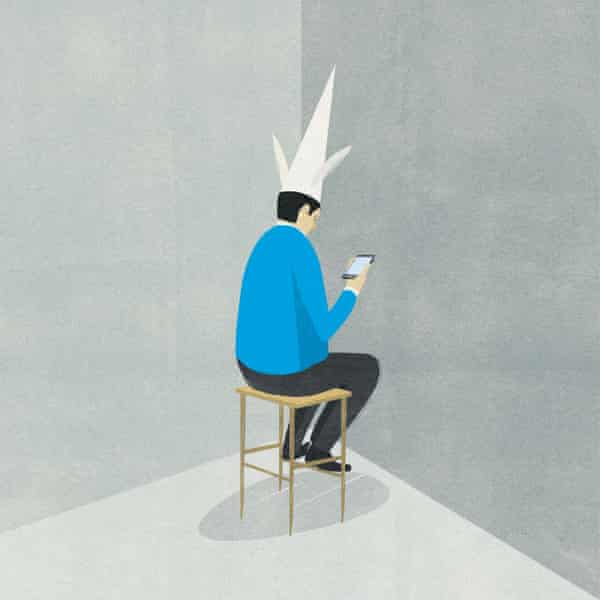
The bear upon of interruptions on individual productivity can too be catastrophic. In 2002, it was reported that, on average, nosotros experience an interruption every 8 minutes or about seven or eight per hour. In an eight-hour day, that is about 60 interruptions. The average pause takes about 5 minutes, then that is about five hours out of eight. And if it takes around fifteen minutes to resume the interrupted activity at a good level of concentration, this means that we are never concentrating very well.
In Baronial 2018, research from the United kingdom'due south telecoms regulator, Ofcom, reported that people cheque their smartphones on average every 12 minutes during their waking hours, with 71% saying they never turn their telephone off and 40% saying they check them within five minutes of waking. Both Facebook and Instagram announced they were developing new tools designed to limit usage in response to claims that excessive social media apply can take a negative touch on mental health.
Continuous partial attention – or CPA – was a phrase coined by the ex-Apple and Microsoft consultant Linda Stone. Past adopting an always-on, anywhere, someday, any place behaviour, nosotros be in a abiding land of alertness that scans the globe but never actually gives our full attention to anything. In the brusque term, we adapt well to these demands, only in the long term the stress hormones adrenaline and cortisol create a physiological hyper-alert state that is ever scanning for stimuli, provoking a sense of addiction temporarily assuaged by checking in.
Myth of multitasking

With our heavy employ of digital media, information technology could be said that we accept taken multitasking to new heights, but we're not actually multitasking; rather, we are switching chop-chop between dissimilar activities. Adrenaline and cortisol are designed to back up us through bursts of intense action, but in the long term cortisol can knock out the feel-good hormones serotonin and dopamine in the encephalon, which help us feel calm and happy, affecting our sleep and heart charge per unit and making us feel jittery.
Information technology would seem so that this physiological adaptation, fostered by our behaviour, is a predominant reason for the poor concentration so many people written report. The fact that we are the cause of this is, paradoxically, good news since it easily dorsum to us the potential to change our behaviour and reclaim the brain function and cognitive health that'south been disrupted by our digitally enhanced lives. And this may fifty-fifty be more important than just improving our levels of concentration. Constant, high levels of circulating stress hormones have an inflammatory and detrimental touch on brain cells, suggests the psychiatrist Edward Bullmore, who has written most the link betwixt inflammation and depression in his latest book, The Inflamed Mind. Depression, along with anxiety, is a known factor in knocking out concentration.
Put simply, better concentration makes life easier and less stressful and we will exist more productive. To make this change means reflecting on what we are doing to sabotage personal concentration, and then implementing steps towards behavioural change that will improve our chances of concentrating better. This ways deliberately reducing distractions and being more self-disciplined most our apply of social media, which are increasingly urgent for the sake of our cognitive and mental wellness.
It takes about 3 weeks for a repeating behaviour to course a habit, says Jeremy Dean, a psychologist and the author of Making Habits, Breaking Habits. Getting into a new habit volition not happen overnight and adaptation tin can be incremental. Start by switching off smartphone alerts, or taking social media apps off your phone, then switching off the device for increasingly long periods.
Practise concentration by finding things to do that specifically engage you for a period of time to the exclusion of everything else. What is noticeable is that you lot cannot just go from a country of distraction to i of concentration, in the same mode that most of us cannot fall comatose the minute our head hits the pillow. It takes a bit of time and, with practice, becomes easier to accomplish.
The 'five more' dominion

This is a elementary manner of learning to concentrate better. Information technology goes like this: whenever yous experience like quitting – just do five more – v more minutes, five more exercises, five more pages – which volition extend your focus. The rule pushes you just beyond the point of frustration and helps build mental concentration. Information technology'southward a form of training every bit well as being a way of getting something achieved.
Sitting nonetheless would seem an easy thing to accomplish. Merely it is harder than it sounds. Information technology is alike to meditation, which can be a useful way to improve concentration. In this example, however, merely get in to a comfortable, supported position and sit still and do nothing for five minutes. Utilize it as a pause betwixt activities. Of course, if you already practise meditation, combine this with breathing for a quick "time out".
Meditation and focus
Switching off from both external and internal distractions does not come up hands. Learning how to be more mindful, practising mindfulness or meditation, can all help facilitate greater concentration, not least because feeling calmer restores equilibrium and focus.
Almost of united states of america breathe poorly: we tend to over-breathe, taking three or four breaths using only the upper part of our lung chapters, when one skilful breath using the lungs more completely would serve u.s.a. amend. This shallow animate is very tiring, not only because nosotros expend unnecessary muscular energy, but considering we reduce our oxygen intake per jiff.
In its extreme form, over-breathing becomes hyperventilation, which can trigger panic attacks. In all mindfulness or meditation practice, breathing is key. And then it's wise to learn good techniques commencement. A daily practice, starting with 10 minutes and building on it, ways that the power to take some restorative "fourth dimension out" volition also be available to you:
-
Lie comfortably on the floor, knees bent, chin tucked in – what Alexander Technique teachers call the "effective rest position" – or sit upright in a chair, legs uncrossed, anxiety flat on the flooring.
-
Consciously relax your neck and drop your shoulders, rest your artillery by your sides with your palms turned upwardly.
-
Breathe long and gently through your nose, into your abdomen until yous run across it gently rise, for a irksome count of five.
-
Interruption, and hold that breath for a count of 5, then gently breathe through your rima oris for another count of five.
-
While doing this, try to clear your mind of all other thoughts, or if this is difficult close your eyes and visualise a pebble dropping into a puddle of water and gently sinking down.
-
Echo this breathing cycle 10 times; then see how your regular breathing adjusts.
-
You can also use this animate technique at any time you feel tense or stressed, or every bit the basis of whatever meditation.
Nosotros all need to accept fourth dimension out, so set a timer to signal a break, or employ an app such as Calm.com. Or you can merely play a favourite music rail, knowing that it will requite yous a set up amount of time in which to press pause and do nada.
Another effective technique for boosting concentration is counting backwards. Counting backwards in sevens from 1,000 might sound like an practise in exasperation, but it does require you to concentrate very hard: try it. Information technology requires persistence and the apply of different skills, which for some may include visualising the numbers as you lot count. Whatever it takes, go on at information technology for long enough to completely focus and you lot'll as well have the added bonus of finding that yous have, temporarily, cleared your head of everything else for a few minutes.
Similarly, spelling words backwards is a adept way to focus: start with words that are easy: domestic dog, box, loving cup, and then build up to longer words – including nouns and more than abstruse words – such every bit absorber, blonde, effort, number – increasing the length and complication of the word. Again, this is an exercise that can be built on.
Another way to focus is to sit in a comfortable position and detect a spot on the wall to stare at. This works all-time when you accept no conscious association with it to distract you – so, a black spot about ii inches in diameter at heart level works well. Focus all your attention on this for around three minutes to get-go with (you can set a timer if this helps) and let any thoughts that arise drift abroad, constantly returning your focus to the spot.
Anyone familiar with meditation will recognise this technique. If it helps to notice your breath, slow and steady this also, but always make your visual focus on the spot the priority. Practiced regularly, this can go so familiar it creates a resource on which to depict, enabling y'all to consciously refocus at will, fifty-fifty without the visual prompt.
Watching the clock
An one-time-fashioned clock face up with hands and a 2nd paw is needed for this. Starting with the second hand at the 12, focus intently on its progress around the clock face up without allowing any distracting thoughts to intervene. Every fourth dimension your concentration is interrupted past a stray thought, wait until the 2d hand is at the 12 again, and showtime again. It'south harder than it sounds and can experience very frustrating initially, but in one case the ability is learnt it's easy to access again and over again, whenever y'all demand to create a more full-bodied country of mind.
We access so much data through what nosotros see, but often we are not particularly observant virtually what we are looking at, leaving the states with just an impression or feeling about what we've seen. In an effort to improve concentration skills, information technology's worth considering how looking at and so visualising something, tin reinforce concentration. Start past paying more attention, whether this is looking at a moving-picture show in an fine art gallery, or taking a bus ride, or but enjoying the scenery from a window. Yous don't have to commit an exact graphic image to retentiveness, but appoint with it, notice details, reflect on it and, within a short time, you will be able to close your eyes and visualise it. There is no right or wrong way to do this, it'southward just an opportunity to practise focus and meliorate concentration.
There's a huge difference between hearing and listening. Learning to listen well starts quite cocky-consciously but volition also become a useful habit. You lot can utilize music to exercise this, the length of a track giving you between three to five minutes (or longer) on which to focus. Really listen to the nuances of the music, its notes, cadences, instruments used, lyrics. Music is oft simply a background racket only real, complicated musical notation tin can be more than just pleasurable, information technology can exist a real boon to helping relearn concentration skills.
Physical do
For any extended period of exercise – whether information technology be yoga, playing a team sport or dancing – the engagement of the brain with the body is too an practice in concentration. Regular practice as well activates the trunk and this is beneficial for the encephalon.
A Dutch study of schoolchildren published in the Periodical of Science and Medicine in Sport in 2016 showed that interspersing lessons with a 20-minute stretch of aerobic exercise measurably improved attention spans in the children that participated. Another 2014 study from the American Academy of Paediatrics, on the benefits of exercise in vii to 9-year-olds, not just found that the children's physical health improved as they got fitter, simply likewise their encephalon function, cognitive functioning and executive control.
Sleep

Poor sleep and being chronically under-slept affects concentration, while also reinforcing those stress hormones to compensate, making information technology a bit of a vicious circumvolve. Improving sleep cannot happen overnight, particularly if information technology is a chronic problem, merely taking measures to improve this will yield results over a menstruation of weeks, rather than days.
I place to offset is clearing your sleeping accommodation of TVs, computers and other technology. Although any type of calorie-free tin inhibit slumber, research has shown that light towards the blue end of the spectrum is specially constructive at keeping you lot awake because it stimulates the retina in the eye and inhibits the secretion of melatonin from the pineal gland in the brain.
Figurer screens, tablets, smartphones, flat-screen TVs and LED lighting all emit large amounts of blue low-cal, and it is important to avoid these before trying to sleep. Effectually fourscore% of people routinely apply these devices running upwards to bedtime, and amid 18 to 24-twelvemonth-olds this figure increases to 91%, co-ordinate to research carried out by Prof Richard Wiseman.
Amber-tinted spectacles tin can cutting out glare, and it is as well possible to fit screens with commercially produced blue-light blocking filters. Another solution, of course, is to avoid all electronic devices before bed in guild to assistance avoid indisposition and improve sleep.
Reading for pleasure
One affair that many people who feel they have lost the ability to concentrate mention is that reading a book for pleasure no longer works for them. We have got so used to skim reading for fast access to information that the need of a more sophisticated vocabulary, a complex plot structure or a novel's length tin be difficult to engage with. Like anything, single-minded attending may need relearning in club to enjoy reading for pleasure again, but close reading in itself tin can exist a route to better concentration. To help that, read from an actual book, non a screen: screens are too reminiscent of skim reading and just turning pages volition tiresome your pace. Read for long enough to engage your involvement, at least thirty minutes: engagement in content takes fourth dimension, merely will help you read for longer.
Digital apps
Somewhat ironically, digital apps may accept their identify in monitoring, managing or restricting digital fourth dimension, but behave in mind that they still go on you connected to digital devices. Better perhaps to wean yourself abroad from excessive digital use by doing something alternative: read a book, go to a movie (where turning off phones is required), take a walk, eat a meal without checking … basically restore some sort of self-subject area through the benefit of alternate activities.
Just if yous must plow to a digital solution to solve a digital problem, try these: track usage with Moment; admission Facebook limiter; go Cold Turkey; effort Stay On Task; use the App detox blocker; or interruption phone addiction with Infinite.
butterfielddishad.blogspot.com
Source: https://www.theguardian.com/lifeandstyle/2018/oct/14/the-lost-art-of-concentration-being-distracted-in-a-digital-world
0 Response to "The Art of Concentration Is a Continual Letting Go"
Post a Comment